
Criminal Court Records in Dewey County
A criminal court record is the case file a court keeps once the state files formal charges. In Dewey County, the District Court hears these cases, and the Court Clerk holds the file from the first filing to the final order. The record tracks the charging document, each hearing, every motion, the plea, and the result. It is a case-level record, not a jail booking sheet. For a closer look at the charges as filed, the Dewey County arrest records and court charges page goes deeper. For the wider set of filings the courts keep, the county court records page covers civil, family, and probate files too.
Oklahoma splits criminal cases by how grave the crime is. A felony case carries the prefix CF and covers the most serious crimes. A misdemeanor case carries the prefix CM and covers lower-level crimes. The District Attorney for District 26 files and prosecutes these cases for the state. The same office serves Dewey and several nearby counties under District Attorney Christopher Boring. Because the state brings the charge, the docket names the District Attorney as a party, just as a Dewey County misdemeanor file does.
Each case sits under one case number. That number is the key to the whole Dewey County criminal court record.
Search Dewey County Criminal Court Records
Two free systems carry Dewey County criminal case dockets. The Oklahoma State Courts Network, known as OSCN, is the official statewide site. On Demand Court Records, known as ODCR, is a second portal where Dewey County is selectable. Both let you search by a person's name or by case number. Dockets post close to real time after the clerk enters them, though coverage can vary by county.
- Open the OSCN docket search and pick Dewey County District Court from the court list.
- Search by the defendant's last and first name, or enter the case number in the CM or CF format.
- Narrow the results by case type, party type, or a filed-date range.
- Open the case to read the docket, the counts, and the disposition.
- If a row reads "available at the Court Clerk's office," call the clerk for a copy.
ODCR works much the same way. Pick Dewey County on the ODCR search form, then search by party name or case number. A single case file is not the same as a full criminal history, though. For a name-based statewide search, the Oklahoma State Bureau of Investigation runs the OSBI CHIRP portal, a fee-based criminal-history service.
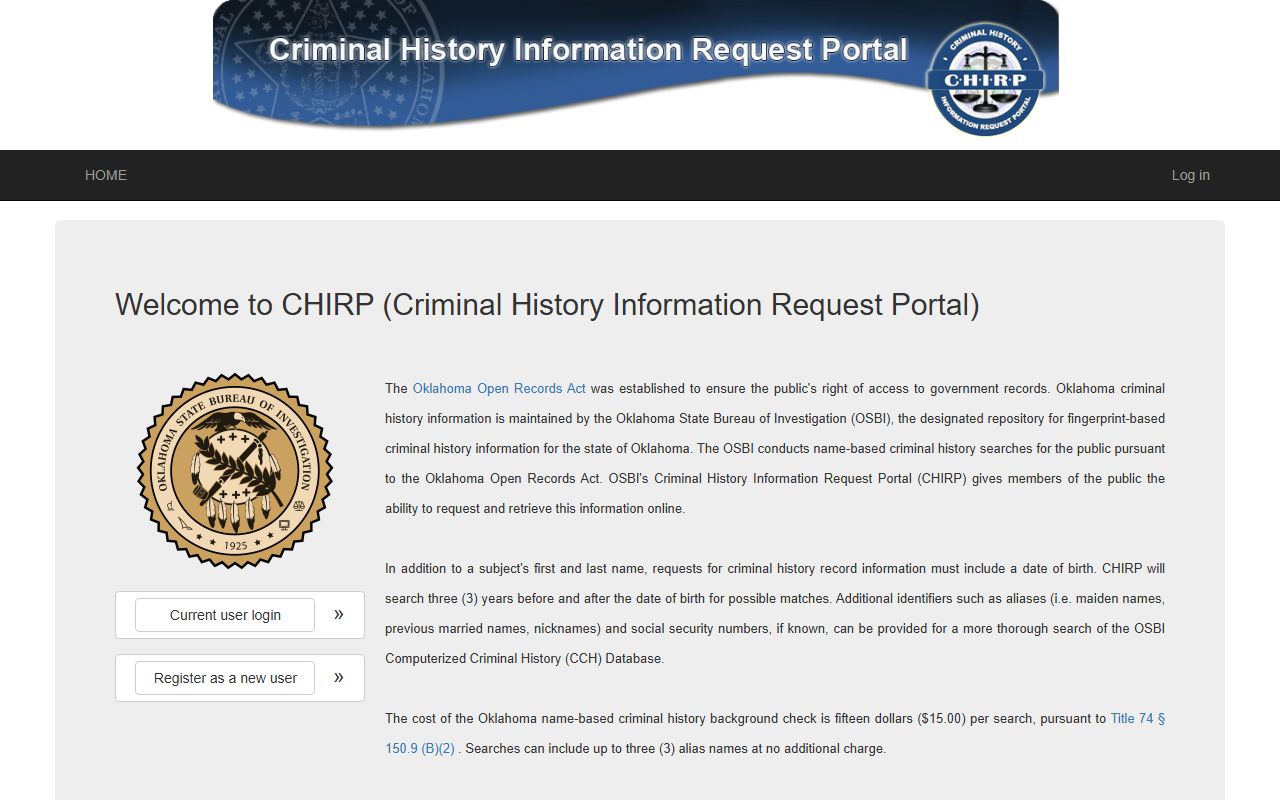
CHIRP returns a person's Oklahoma criminal-history summary, but it is not a live warrant list and does not replace the Dewey County case docket. Use it as a backstop when a single court file is not enough.
Note: OSCN warns that its public docket is not the official record and should be checked against the Court Clerk's file before you rely on it.
Stages of a Dewey County Criminal Case
A Dewey County criminal case moves through set stages, and each one leaves a mark on the record. The file starts when the District Attorney files an information, the formal charging document. From there the case heads toward a plea or a trial, then to a final outcome.
Case flow: Charges Filed › Arraignment › Pretrial & Motions › Plea or Trial › Disposition › Sentencing
At arraignment the court reads the charges, and the defendant enters a plea. The judge also addresses bond and the right to a lawyer. When a defendant cannot afford counsel, the court may appoint one through the Oklahoma Indigent Defense System, which covers Dewey County from its Woodward regional office. The pretrial phase brings motions, continuances, and hearings, and each filing shows up as a docket line. The case then ends with a plea or a trial. Most cases close with a plea. A disposition records the outcome, such as guilty, dismissed, or acquitted. If there is a conviction, sentencing follows, and the record notes jail or prison time, probation, fines, and court costs. Payment plans, like the Rule 8 plan seen in Dewey misdemeanor files, also land here.
What Dewey County Criminal Records Show
An open Dewey County criminal case page shows the same core fields, whether the charge is a felony or a misdemeanor. The inspected CM-2024-00001 misdemeanor file is a clear model. It lists the court header, the case style, the parties, the counts, and a dated docket of every action.
| Field | What It Shows |
|---|---|
| Case Number | The unique case ID, such as CM-2024-00001; the prefix marks felony (CF) or misdemeanor (CM). |
| Case Style | The caption, listed as State of Oklahoma vs. the named defendant. |
| Filed Date | When the charge was filed, for example 01/12/2024. |
| Judge | The judge assigned to the case, such as the Honorable Celo J Harrel. |
| Parties | The defendant, the District Attorney, and the arresting officer and agency. |
| Counts | Each numbered charge with its description and status, like Petit Larceny (Dismissed). |
| Docket Entries | A dated table of filings, hearings, minutes, and orders by code and description. |
| Disposition | The case outcome, such as dismissed, convicted, or acquitted. |
| Sentence & Costs | Any punishment, plus filing fees, assessments, and payment-plan orders. |
Reading Dewey County Dispositions and Sentences
The disposition is the heart of any Dewey County criminal record. It tells you how the case ended. A few terms come up again and again, and each one means something different for the person named in the file.
- Guilty
- A finding or plea that establishes guilt and leads to a sentence.
- Not Guilty
- A verdict that clears the defendant of the charge.
- Dismissed
- The charge was dropped; "with prejudice" means it cannot be refiled, while "without prejudice" means it may.
- Nolo Contendere
- A no-contest plea, where the defendant does not admit guilt but accepts the penalty.
- Deferred Sentence
- Judgment is delayed while the defendant meets set conditions; the case may later show as dismissed.
- Suspended Sentence
- A sentence is imposed but its service is held back under terms the court sets.
Note: Court costs, fines, and restitution stay due even after a case closes, and unpaid balances can trigger a payment-plan order or a bench warrant.
Charges vs. Convictions in Dewey County
Being charged is not the same as being convicted. A Dewey County criminal court record can list charges that were later dropped, dismissed, or ended in acquittal. A charge is only an accusation. A conviction is a finding of guilt by plea or verdict. Reading the two as the same thing is a common and costly mistake.
| Charge | Conviction | |
|---|---|---|
| Stage | Accusation | Verdict or plea |
| Burden of Proof | Probable cause | Beyond a reasonable doubt |
| Who Decides | The District Attorney | Judge or jury |
| Public Record | Yes | Yes |
| Effect | Case is open or pending | A sentence may follow |
A clean look at the disposition tells you which one you are reading.
Public Access to Dewey County Records
Oklahoma treats court records as open by default. The state Open Records Act makes most District Court files, including Dewey County criminal cases, public for inspection and copying. Court rules then carve out narrow exceptions for material the law makes confidential. So most dockets are free to read online, while a smaller set stays restricted or clerk-only.
Key Statutes:
Oklahoma Open Records Act, 51 O.S. § 24A.1 - Most public-body records, including court files, are open unless a statute makes them confidential.
Oklahoma Court of Criminal Appeals Rule 2.6 - Some records, such as juvenile files, are withheld from internet display and may require in-person clerk access.
Sealed vs. Expunged Dewey County Records
Some Dewey County criminal records can be sealed or expunged, but the two are not the same. Sealing hides a record from public view. Expungement, under Oklahoma law, can erase an arrest record so it is treated as if it never happened. The main expungement and sealing rules sit in Title 22 of the Oklahoma Statutes.
The Oklahoma State Bureau of Investigation lays out the two main paths on its criminal-history expungement page.
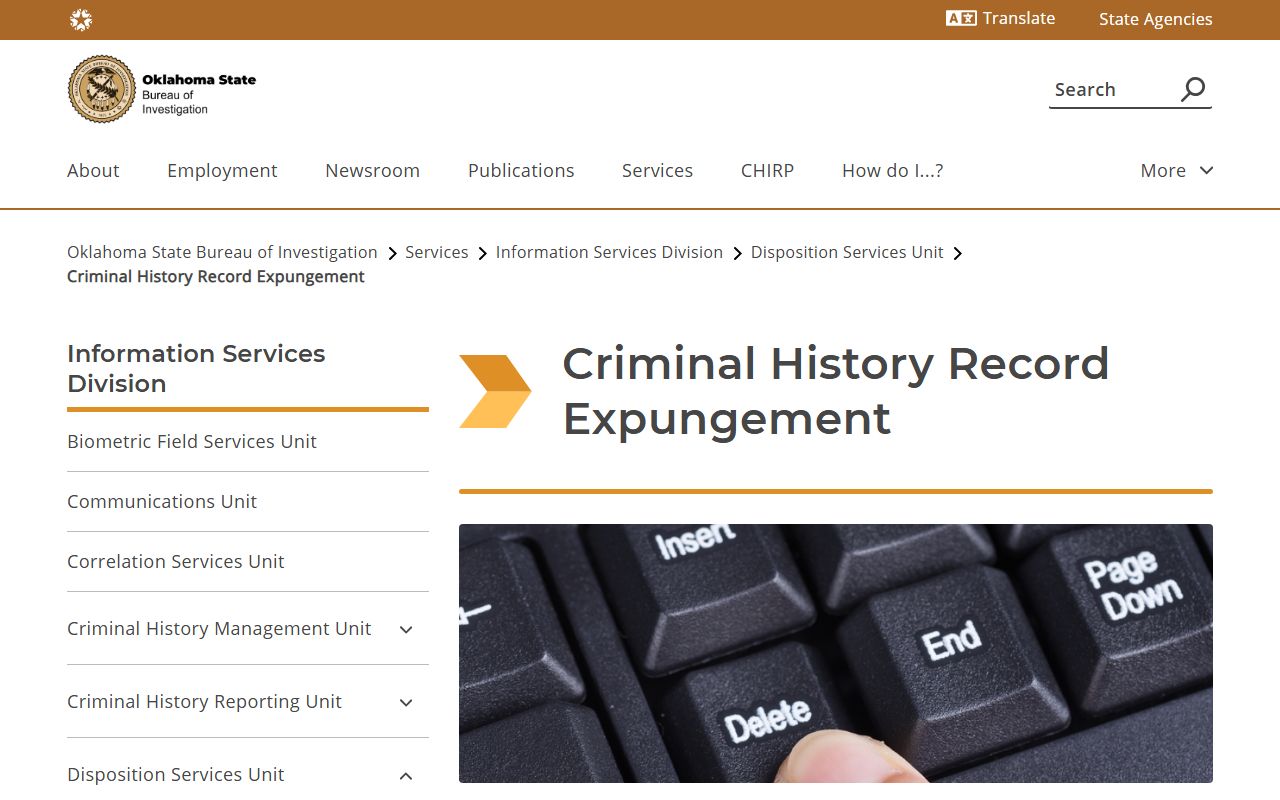
It draws a sharp line between a full Section 18 expungement and a 991(c) update, and that line shapes what a Dewey County record shows afterward.
| Sealed | Expunged | |
|---|---|---|
| Visibility | Hidden from the public docket | Treated as if it never existed |
| Law Enforcement | Limited access | Very limited access |
| Oklahoma Path | A 991(c) order makes a deferred case read as dismissed | A Section 18 order expunges the full arrest record |
| Arrest Record | Often remains | Removed for qualifying cases |
Note: A 991(c) update makes a deferred case read as dismissed, yet the underlying arrest record stays in state files unless a Section 18 expungement is granted.
Restricted Dewey County Criminal Records
Not every Dewey County criminal record is open to the public. Several categories are sealed or restricted by law, and the online docket may hide the case or limit its detail. Some files exist only in paper form at the Court Clerk's office in Taloga.
- Juvenile and youthful-offender records, which Title 10A keeps largely confidential.
- Sealed and expunged cases, which drop off or thin out on the public docket.
- Mental-health proceedings, which can be closed except by court order.
- Personal identifiers, such as Social Security and account numbers, which are redacted.
- Some search-warrant filings, which may stay private before they are executed.
Oklahoma has also begun clearing some records on its own through the OSBI Clean Slate initiative.
The program runs state-initiated expungements for qualifying cases, which can change what a Dewey County criminal record shows without the person filing a petition. For an older, sealed, or clerk-only file, the Court Clerk is the office that can confirm what is releasable.
Background Check Considerations
Many people read Dewey County criminal records out of plain curiosity or for personal safety. Others need them for hiring, housing, or licensing. Those last uses fall under the federal Fair Credit Reporting Act, which sets strict rules for formal background checks. A casual docket search is not the same as an FCRA-compliant report, and the difference matters in court.
A formal report also weighs charges and convictions differently than a quick name lookup does. A dismissed charge in a Dewey County file still appears on the docket, yet it is not a conviction. Read each case to the disposition before you draw any conclusion about a person.
Important: This site is not a consumer reporting agency under the Fair Credit Reporting Act, and its information may not be used for employment, tenant, credit, or other FCRA-regulated decisions.