
How to Search Dewey County Court Records
Dewey County District Court records are searchable online. The Oklahoma State Courts Network, known as OSCN, is the official statewide system. On Demand Court Records, or ODCR, is a second public option. Both list Dewey County District Court in their court menus. OSCN pulls its data straight from the working dockets of the district and appellate courts. New entries show up close to real time after the clerk types them, though coverage can vary by county.
Have a few details ready before you start. A full name, a case number, or a citation number all help narrow the search. The OSCN docket page offers a case-number lookup and links to its full search form.
The screenshot below comes from the OSCN docket landing page, the main entry point for case lookups.
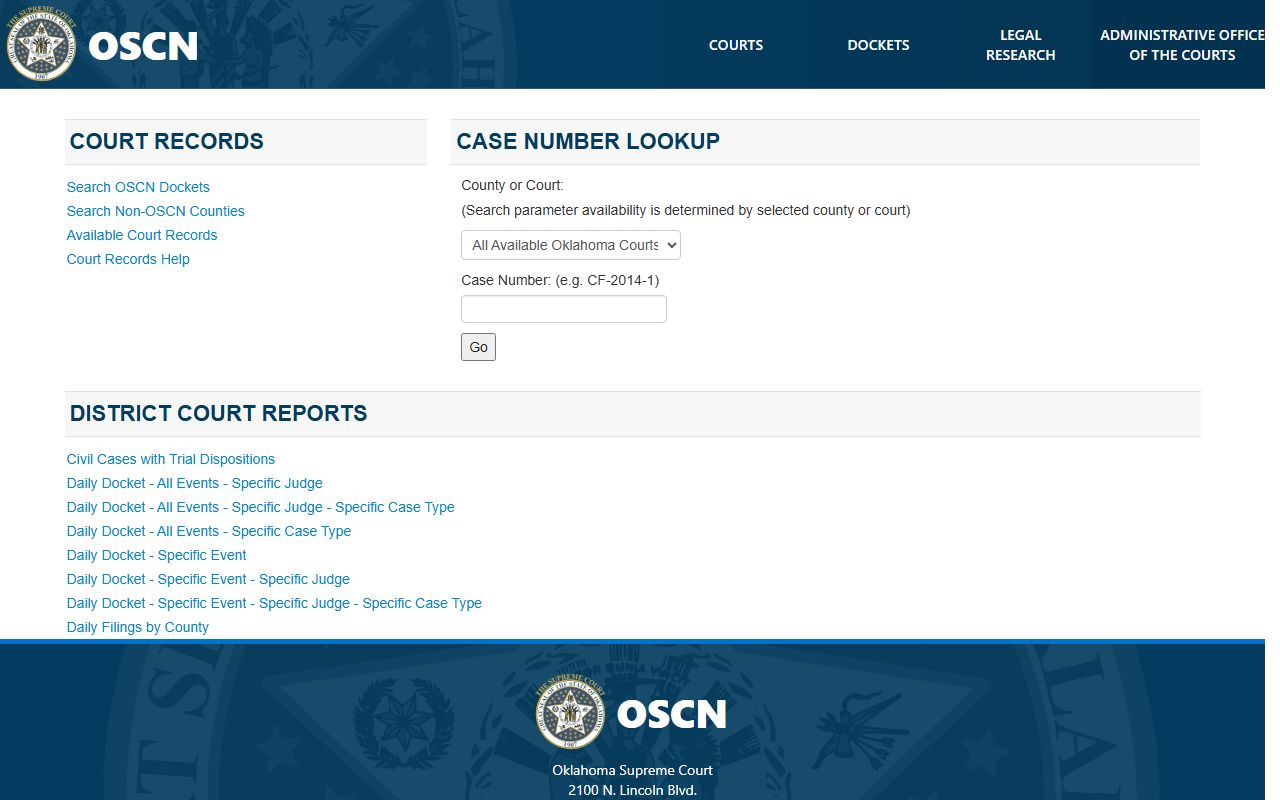
From this page a reader picks Dewey County District Court, then searches by name or case number. The same site links to court-records help and a list of available courts.
- Open the OSCN docket portal and choose Dewey County District Court in the court menu.
- Enter a party name in the last-name field, or type a case number such as CM-2024-1.
- Narrow the results with a case type, a filed-date range, or a date of birth where it applies.
- Open the matching case and read the docket entries, events, and party list.
- Request a certified copy from the Court Clerk if a document is marked for office pickup only.
The OSCN search form accepts many fields. Use wildcards with care. A percent sign or an underscore can stand in for letters, but loose wildcards return too many cases.
| Field | Type | Notes |
|---|---|---|
| County or Court | Dropdown | Select Dewey County District Court to limit results. |
| Case Number | Text | Format like CM-2024-1; optional when searching by name. |
| Last Name | Text | Holds business names as well as people. |
| First Name | Text | Narrows a person search. |
| Case Type | Dropdown | Civil, felony, misdemeanor, family, probate, traffic, and more. |
| Citation Number | Text | District traffic tickets only; it does not search municipal citations. |
The advanced view sits on the OSCN court-record search form, which exposes every field at once.
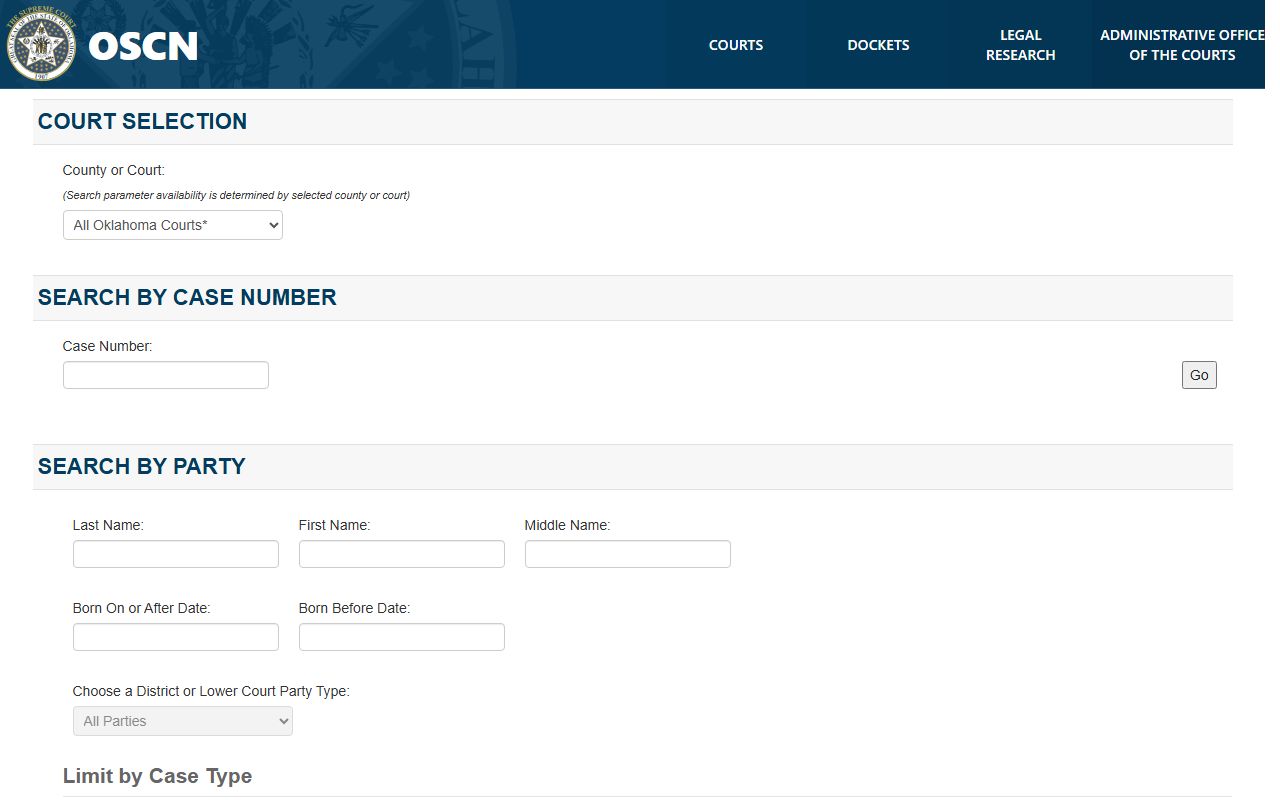
This form lets a reader combine a name, a case type, and a date range in one query, which trims a long Dewey County result list fast.
Note: OSCN states that its public page is not the official record and that details should be confirmed with the Court Clerk before you rely on them.
The Dewey County Judicial System
Oklahoma runs a single trial court of general jurisdiction. That court is the District Court. Dewey County is one of the state's county district courts and falls within Judicial District 4, a group of rural counties in the northwest. The District Court judge hears both civil and criminal cases.
Appeals split by case type. Civil appeals go to the Oklahoma Supreme Court, which may pass cases to the Oklahoma Court of Civil Appeals. Criminal appeals go to the Oklahoma Court of Criminal Appeals. There is no single regional court of appeals as in many other states.
Case flow: Dewey County District Court › Court of Civil Appeals or Court of Criminal Appeals › Oklahoma Supreme Court
The image below is from the OSCN Dewey County court page, which carries a courthouse photo and county data.
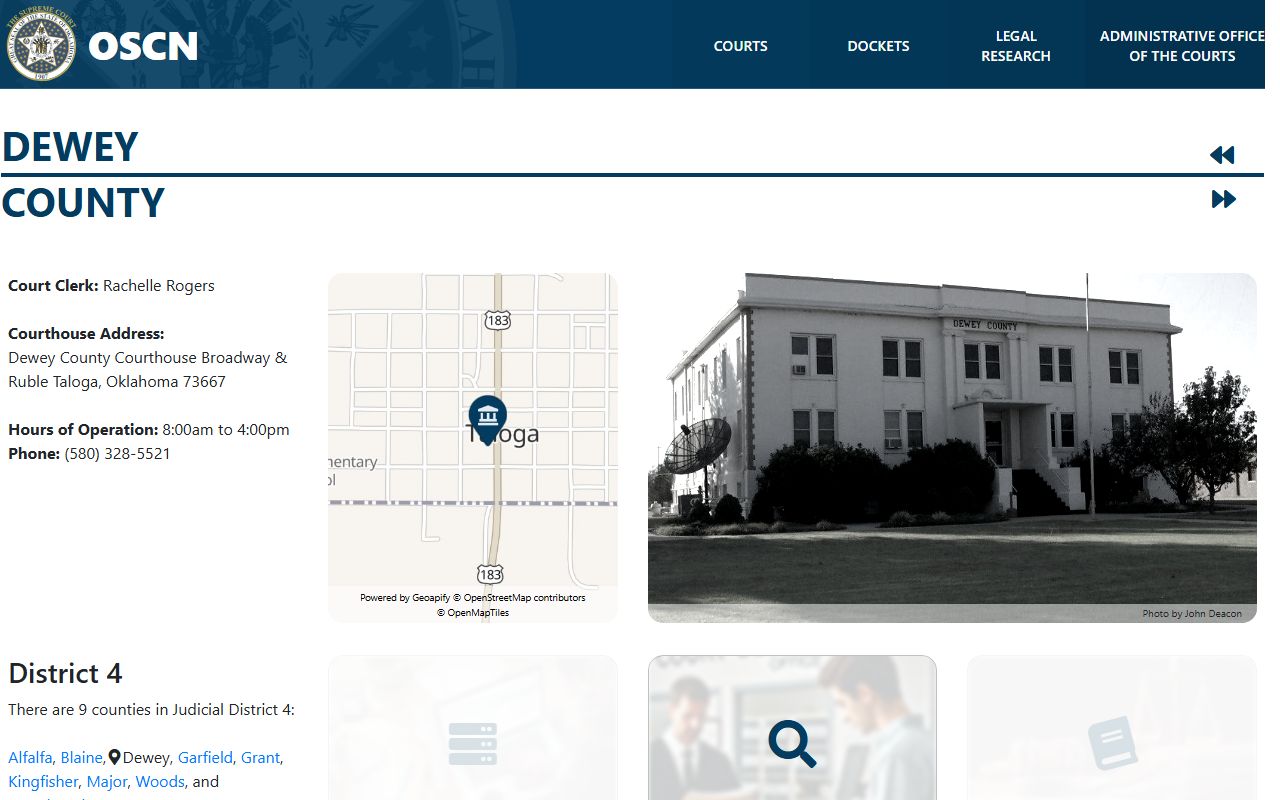
This county page ties Dewey to its district and links its docket data. Most everyday matters, from a small-claims dispute to a felony charge, start and stay in the District Court.
Trial and Municipal Courts in Dewey County
Not every case sits in the District Court. Towns run their own municipal courts for local ordinance and traffic matters. Seiling, which contracts with the Dewey County Sheriff's Office for policing, operates a municipal court of its own. Some citations from Seiling, Vici, Leedey, and other towns may never appear in the district-court system.
The table compares the courts a Dewey County resident is most likely to meet.
| Court | What It Handles | Where Appeals Go |
|---|---|---|
| District Court | Civil, criminal, family, probate, small claims, protective orders, and district traffic. | Oklahoma Supreme Court or Court of Criminal Appeals. |
| Municipal Court | City ordinance violations and many local traffic tickets. | District Court review under state rules. |
| Appellate Courts | Reviews of trial-court decisions in civil and criminal cases. | Final state review. |
This split matters for tickets and warrants. A municipal case usually stays with the town court, so a reader may need both the city clerk and the county Court Clerk to get the full picture.
Types of Court Records in Dewey County
The District Court produces a wide mix of files. The case type sets what the record holds and how open it is. Civil files cover money disputes, judgments, liens, and garnishments. Criminal files cover felony and misdemeanor charges. Family files hold divorce and related domestic matters.
Each record type carries its own access rules. Most are public, yet some carry redacted or sealed parts. The list below sums up the main groups searchable for Dewey County.
- Criminal records - felony and misdemeanor cases with charges, pleas, and dispositions.
- Civil records - petitions, judgments, small claims, and liens filed in the District Court.
- Family and divorce records - divorce decrees and domestic cases, with sensitive parts limited.
- Probate records - estates, wills, guardianships, and trusts.
- Traffic records - district traffic citations and related charges.
What Dewey County Court Records Show
A Dewey County case page packs a lot into one view. The header names the court and the county. The case style lists the parties, such as the State of Oklahoma against a named defendant. Below that sit the case number, the case type, the filed date, and the assigned judge.
The body of the record is the docket. Each row carries a date, a code, a short description, and sometimes a dollar amount. Some documents are linked as a PDF or a TIFF. Others are marked as available only at the Court Clerk's office. The table breaks down the core fields.
| Field | What It Shows |
|---|---|
| Case Number | The unique court ID, such as CM-2024-00001. |
| Filing Date | The day the case opened with the Court Clerk. |
| Parties | Defendant, district attorney, arresting officer, and agency. |
| Counts | Each numbered charge and its current status. |
| Disposition | The outcome, such as dismissed, convicted, or settled. |
| Costs | Fees and fines, with any payment-plan entries. |
Plain language helps when a docket reads like code. A short glossary covers the terms that come up most often in a Dewey County file.
- Plaintiff
- The party that brings a civil lawsuit.
- Defendant
- The party sued or charged with a crime.
- Disposition
- The case outcome, such as dismissed or convicted.
- Bench warrant
- A warrant a judge issues, often for a missed court date.
- Certified copy
- A copy the clerk authenticates for official use.
Note: a sample Dewey misdemeanor docket showed counts, court minutes, and cost rows in the same file, so read the whole docket and not just the top.
Public Access Laws for Dewey County Records
Oklahoma treats court files as public by default. The state Open Records Act sets that rule, and case law backs it. Records stay open unless a statute or a court order makes them confidential. The District Court and the Court Clerk both work under these laws.
A few statutes shape what a reader can and cannot see. Each one below is paired with a short plain-English note.
Key Statutes:
51 O.S. § 24A.1 - the Open Records Act makes public records open unless a law marks them confidential.
51 O.S. § 24A.5 - records are open for inspection and copying during regular business hours, with set exemptions.
22 O.S. §§ 18 and 19 - these sections govern the sealing and expungement of qualifying criminal records.
OCCA Rule 2.6 - certain materials, including juvenile records, are withheld from internet display.
The lead image here is from the Oklahoma District Courts overview, which explains how trial courts and appeals work.
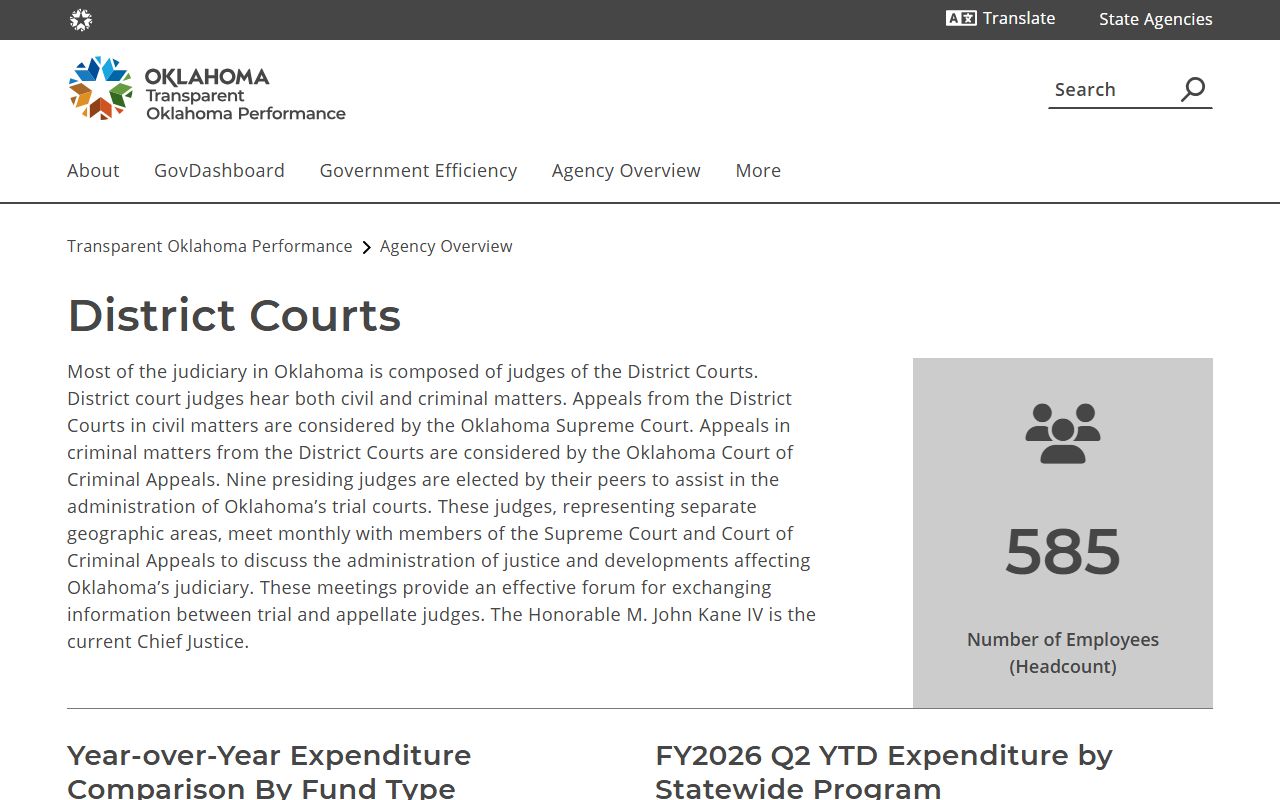
The state page confirms that district judges hear civil and criminal matters and that appeals split between the Supreme Court and the Court of Criminal Appeals.
Court Clerk and County Clerk Roles
Oklahoma splits local records between two offices. The Court Clerk handles district-court case files and marriage licenses. The County Clerk records land documents like deeds, mortgages, liens, and oil-and-gas instruments. Sending a request to the wrong office wastes time, so the split is worth knowing.
The directory image below comes from the Dewey County official services page, which lists each elected office.
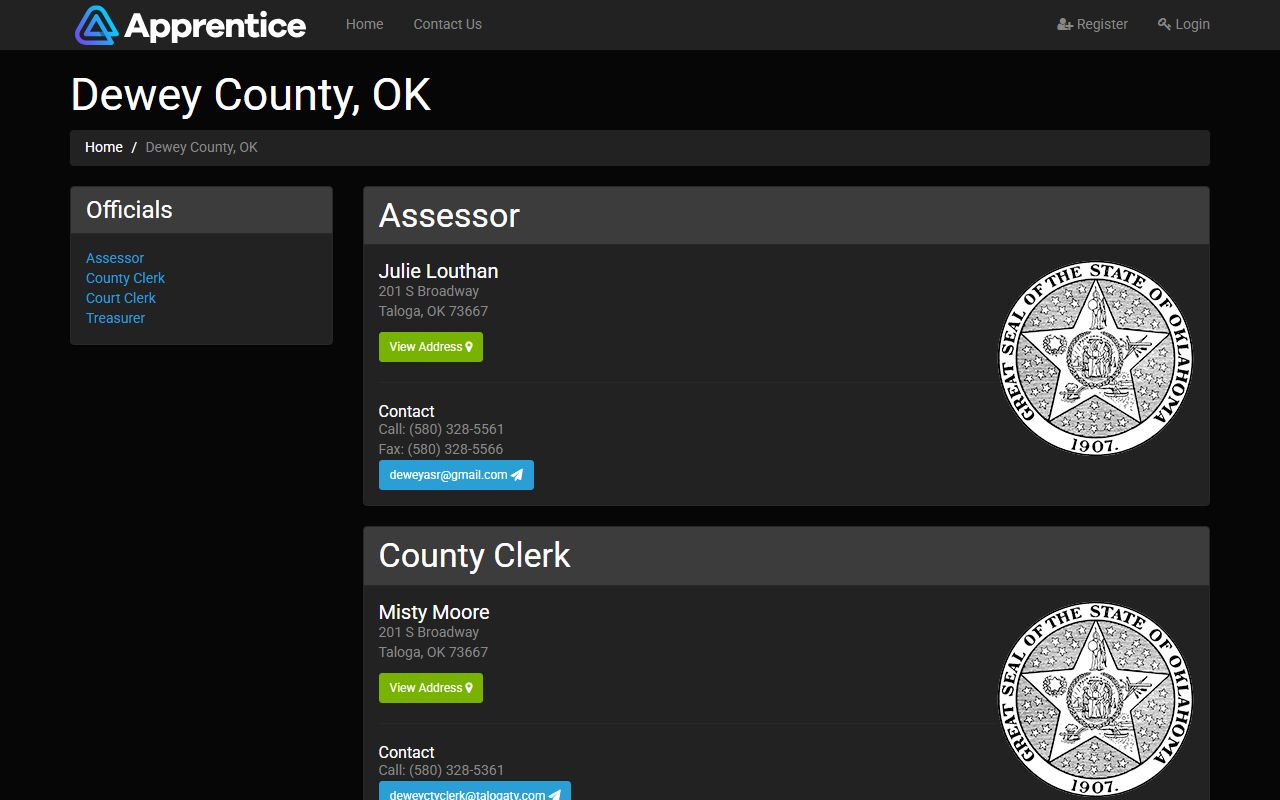
That page lists the Court Clerk and the County Clerk with separate addresses and phone numbers. The County Clerk also runs a searchable land-record portal at OKCountyRecords for Dewey County, with indexed data from March 2000.
| Feature | Court Clerk | County Clerk |
|---|---|---|
| Main records | District-court cases and marriage licenses. | Deeds, mortgages, liens, and plats. |
| Search tool | OSCN and ODCR dockets. | OKCountyRecords land portal. |
| Phone | (580) 328-5521 | (580) 328-5361 |
| Use it for | Case copies, sealed files, payment plans. | Recorded land and judgment instruments. |
Restricted and Confidential Dewey County Records
Some records stay closed even though most files are public. Juvenile cases are the clearest example. Court rules and state law keep many juvenile, agency, and law-enforcement juvenile records out of public view. The online docket may show a category without opening the documents.
Sealed and expunged files also drop from public access. A full expungement under Section 18 can erase an arrest record, while a deferred-sentence update changes a disposition to dismissed without removing the arrest. Adoption files and many mental-health proceedings are confidential as well. Personal data like Social Security numbers, financial accounts, and protected addresses can be redacted even in an open case.
To view a sealed record, a person usually needs a court order or proof of eligibility. The process starts in the District Court, and the petition is filed with the Court Clerk. The judge decides whether the record opens.
Note: research did not find a Dewey-specific expungement packet or fee, so call the Court Clerk at (580) 328-5521 for the current filing cost and local hearing steps.
Dewey County Court Records Fees
Copy fees depend on which office holds the record. District-court case copies and certified documents come from the Court Clerk, and the office sets those charges at the counter. The County Clerk publishes a clearer recording and copy schedule for land instruments.
The table lists County Clerk recording and copy fees from the published Oklahoma county-clerk schedule. Court case-copy costs are not on this table; ask the Court Clerk for those.
| Item | Amount |
|---|---|
| First page (deed, mortgage, instrument) | $8.00 |
| Each additional page | $2.00 |
| Preservation and archiving fee | $10.00 per instrument |
| Photographic copy | $1.00 per page |
| Certifying a copy | $1.00 per page |
| Documentary stamp tax | $0.75 per $500 of value |
Filing fees in a criminal case look different. A sample Dewey misdemeanor docket showed an $83.00 charge to file the information, plus smaller assessments for the law library, the sheriff's fee, and a trauma fund. Payment plans can spread these costs over time.
Specialty Courts in Dewey County
Oklahoma runs treatment-based courts across the state. Adult drug courts give eligible non-violent felony defendants a path into supervised treatment instead of prison. The state reports drug-court programs in most of its 77 counties.
Dewey County is small and rural, so specialty programs are often run across a multi-county district rather than from a Dewey-only office. Research did not find a local drug-court page, a named presiding judge, or enrollment figures for the county. A reader who wants to know about a treatment court should ask the Court Clerk or the District Attorney directly.
The same is true for veterans courts and mental-health diversion. No Dewey-specific program page surfaced. Treat the statewide programs as context and confirm any local docket with the county before relying on it.
Dewey County Sheriff and Jail
The Dewey County Sheriff's Office is the local point of contact for jail custody and warrants. The current sheriff is L. Clay Sander. The office phone line is (580) 328-5558, and the county jail sits in Taloga. The county has a thin online footprint, so the phone is often the fastest channel.
Important: No official Dewey County sheriff-hosted inmate roster or warrant list was found, so avoid third-party lookup sites and call the office to confirm custody or a warrant.
For custody questions, several official channels exist. Call the jail to confirm a booking, a bond, or a release. Use the statewide notification service for custody-status alerts. Check the Oklahoma DOC offender lookup for someone serving a state prison sentence after they leave the county jail. The county-level detail lives on the Dewey County inmate records page, and active-warrant fallbacks sit on the warrant records page.
Note: a small county jail may reject mail or money that does not match current policy, so call before you send anything to a person in custody.
Marriage, Divorce, and Probate Records
The Court Clerk, not the County Clerk, handles marriage licenses in Oklahoma. Dewey County license questions go to that office at (580) 328-5521. Marriage records show up under a marriage-license case type in the court systems, and certified copies come from the clerk. The common license fee is reduced when applicants complete qualifying premarital counseling.
Divorce is a District Court family matter, not a land record. Search OSCN or ODCR by name or by a family case type, then request certified copies from the Court Clerk if the docket is older or limited. Sensitive details involving children or finances may be sealed. The marriage and divorce records page covers the steps in full.
Probate also runs through the District Court. Estates, wills, guardianships, and trusts all file there. Older probate files may predate digital coverage, so the Court Clerk holds the paper. Deeper guidance lives on the probate records page.
Federal Court Records for Dewey County
Federal cases are separate from county cases. Dewey County falls within the U.S. District Court for the Western District of Oklahoma. Federal criminal charges, federal civil-rights suits, and federal-question litigation move through that court, not through OSCN or ODCR.
Federal dockets sit in a different system. The Western District of Oklahoma publishes its own information, and the actual case files live in the national PACER system. A reader who cannot find a case in the county dockets and expects a federal matter should check the federal channels instead.
Dewey County Courthouse Location
County offices cluster in Taloga, the county seat. The courthouse stands in the Broadway and Ruble Street area. Three offices matter most for records: the Court Clerk for cases, the County Clerk for land, and the District Attorney for prosecution. The cards below give each one.
Dewey County Court Clerk
Ruble Ave / P.O. Box 278
Taloga, OK 73667
(580) 328-5521
oscn.net
Dewey County Clerk's Office
201 S Broadway
Taloga, OK 73667
(580) 328-5361
okcountyrecords.com
District Attorney, District 26
P.O. Box 276
Taloga, OK 73667
(580) 328-5541
The image here is from the Oklahoma SHPO National Register record for the historic courthouse.
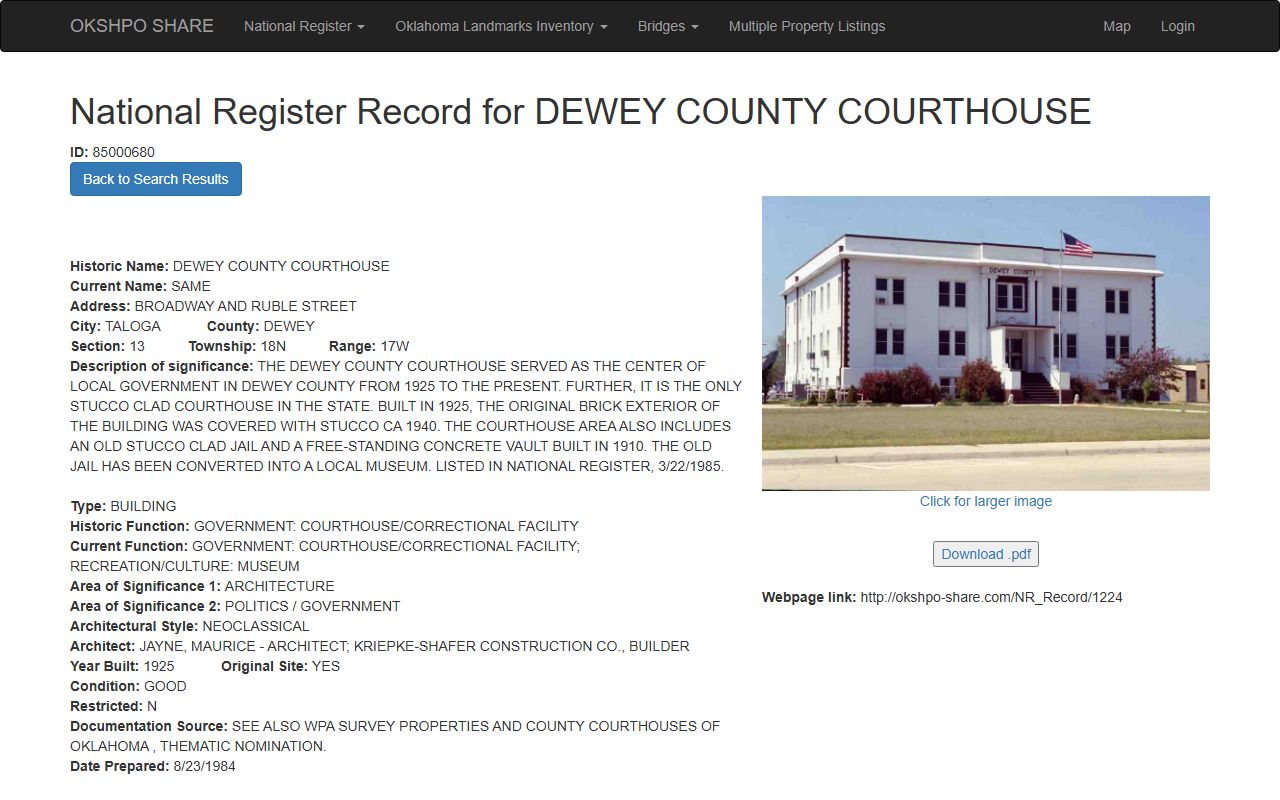
The record notes a rare local detail: it is the only stucco-clad courthouse in Oklahoma. An old jail, now a museum, and a 1910 concrete vault round out the complex.
Note: do not mail court case-copy requests to the County Clerk's land-record P.O. box unless the record you want is a recorded land instrument.
History of Dewey County Courts
Dewey County began as "D County" and took its name in the general election of November 1898. Early commissioners rented space in a two-story brick building. A wood-frame building at Main and Broadway served as county offices in 1909. The modern courthouse was finished in the mid-1920s and later joined the National Register of Historic Places.
Taloga has held the county seat since before statehood. The town had several hundred residents by 1898, and a courthouse stood there as early as 1901. The county's court-record system is now modern through OSCN and ODCR, yet the courthouse roots run older than Oklahoma's current court structure. Pre-digital land, probate, and civil files often need a direct call to the clerk.
The figure below is from U.S. Census QuickFacts for Dewey County.
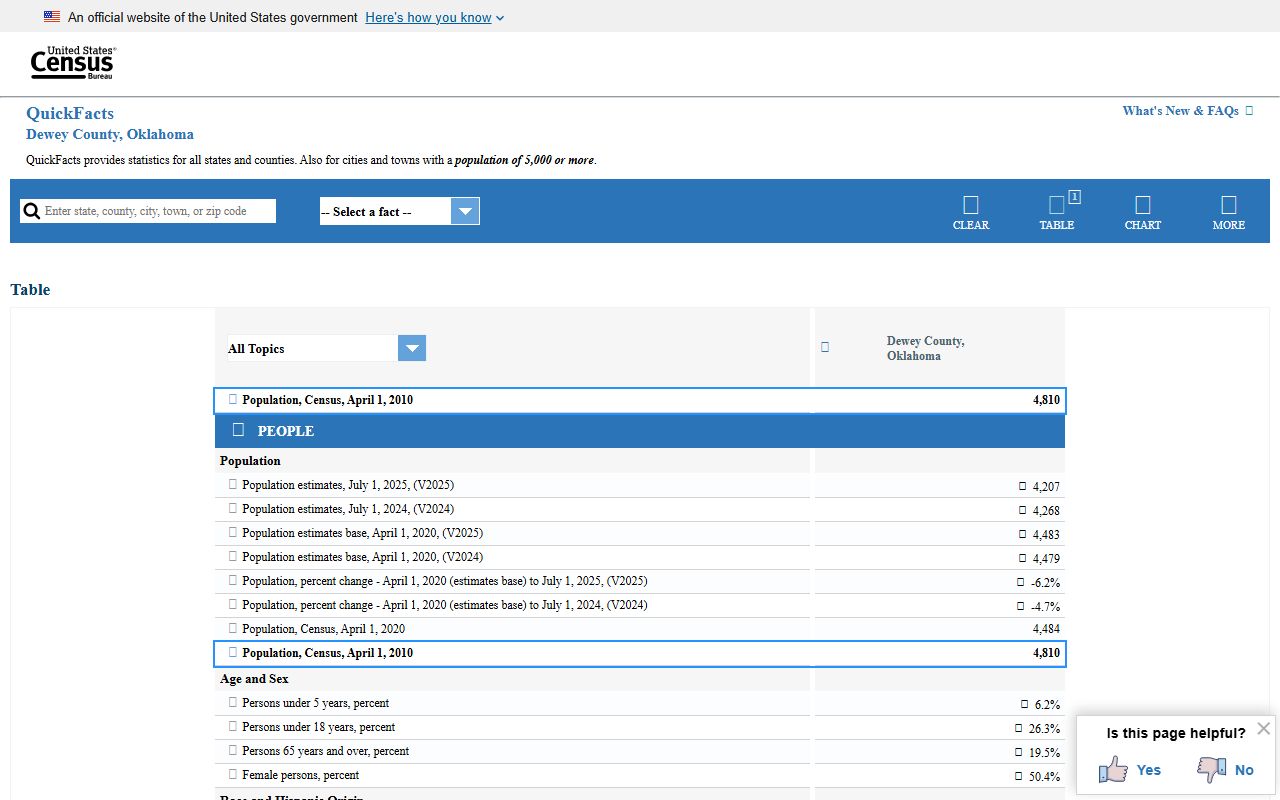
The county is small. The 2024 estimate was about 4,268 residents, with a 2020 Census count of 4,484. That rural scale shapes how a visitor plans a trip and how records are kept.
Frequently Asked Questions
How do I search Dewey County Court records online?
Use OSCN or ODCR. Both list Dewey County District Court in their menus. Pick the court, then search by a party name, a case number, or a citation number. OSCN pulls data from the working dockets, so most entries appear close to real time. If a document is marked for office pickup only, ask the Court Clerk for a copy.
What is the difference between the Court Clerk and the County Clerk?
The Court Clerk keeps district-court case files and marriage licenses. The County Clerk records land documents like deeds, mortgages, and liens. For a divorce, a criminal case, or a probate file, call the Court Clerk at (580) 328-5521. For a deed or a recorded judgment, use the County Clerk and its land-record portal.
Are Dewey County court records public?
Most are. The Oklahoma Open Records Act keeps court files open unless a statute or a court order makes them confidential. Juvenile, sealed, adoption, and many mental-health records are restricted. Personal data such as Social Security numbers may be redacted even in an open case.
How do I check for a warrant in Dewey County?
No official online warrant list was found for the county. Call the Dewey County Sheriff's Office at (580) 328-5558 to confirm a warrant and ask about surrender. The Court Clerk can confirm bench-warrant and failure-to-appear status in a District Court case. A Seiling municipal ticket may need a call to that city court instead.
Can I get a certified copy of a Dewey County case?
Yes. Certified copies come from the Court Clerk. Contact the office at (580) 328-5521 for the current cost and for older files that are not scanned online. A certified copy is the version courts and agencies accept for official use.